Research is an important part of education, business, marketing, and technology. However, collecting information from different websites, reviewing documents, comparing sources, and preparing reports can take hours. Artificial intelligence is changing this process by introducing smarter research systems that can complete multiple steps with less manual effort.
An autonomous AI research agent is an intelligent system that can investigate a topic, search for relevant information, analyze different sources, and organize findings into useful reports. Unlike traditional AI chatbots that mainly respond to individual questions, research agents can follow a series of instructions and work through multiple research tasks.
In 2026, these systems are becoming increasingly useful for students, freelancers, marketers, entrepreneurs, and professional researchers. They can help explore complex topics, identify important trends, compare products, and summarize large amounts of information.
This guide explains how autonomous AI research agents work, explores seven useful tools, and shows how to use them effectively.
What Is an Autonomous AI Research Agent?
An autonomous AI research agent is an AI-powered system designed to perform research tasks with limited human intervention.
It uses language models, search capabilities, reasoning, and connected tools to investigate a particular subject.
For example, if someone asks an agent to research the latest AI marketing trends, it may break the request into smaller tasks, search different sources, compare information, and prepare a structured summary.
Common capabilities include:
- Searching the internet for relevant information.
- Reviewing multiple sources.
- Summarizing articles and documents.
- Comparing facts and findings.
- Identifying patterns and trends.
- Organizing research notes.
- Preparing reports with references.
- Answering follow-up research questions.
The level of autonomy depends on the platform. Some tools require users to approve every important step, while others can complete longer workflows independently.
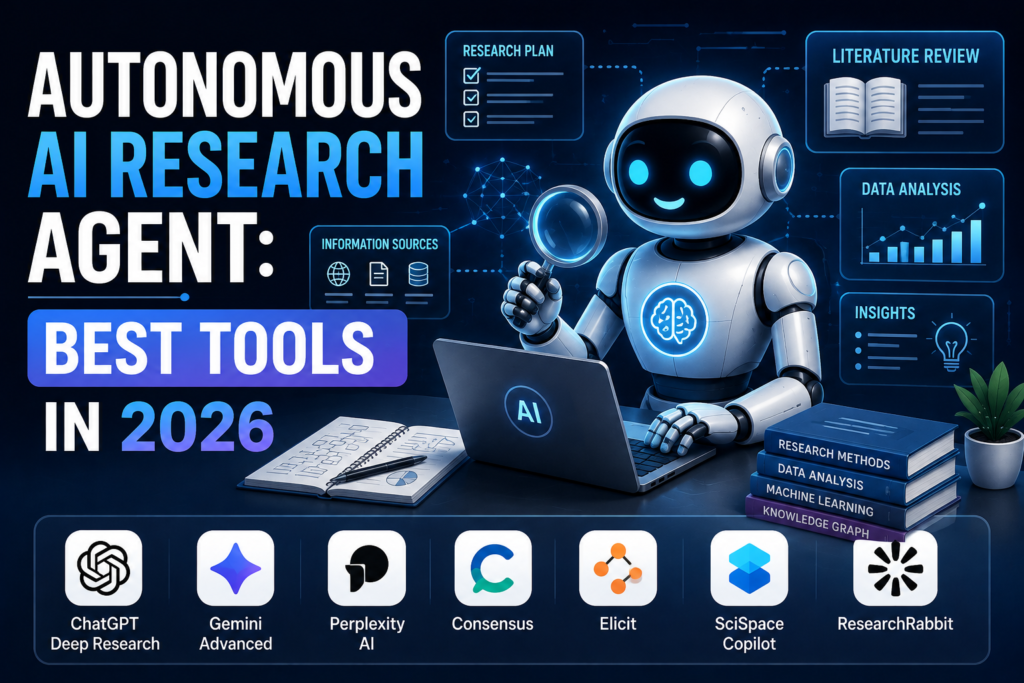
7 Best Autonomous AI Research Agent Tools in 2026
Different platforms offer different research capabilities. Here are seven tools worth exploring.
1. OpenAI Deep Research
OpenAI Deep Research is designed to handle complex research requests that require multiple steps.
Instead of producing a quick response, it can investigate a subject, review online sources, compare information, and prepare a detailed report with citations.
Key Features:
- Multi-step research workflows.
- Online source discovery.
- Detailed research reports.
- Source citations.
- Complex topic analysis.
- Follow-up research capabilities.
For example, a business owner can ask it to investigate competitors, compare industry developments, and identify important market opportunities.
It is particularly useful when a task requires more than a simple internet search. Availability and usage limits depend on the ChatGPT plan.
2. Google Gemini Deep Research
Google Gemini Deep Research helps users investigate complicated topics through an organized research process.
It can develop a research plan, explore relevant sources, and create reports that combine information from different materials.
Key Features:
- Multi-source research.
- Research planning.
- Detailed summaries.
- Google ecosystem integration.
- Report generation.
- Source references.
Students can use it to explore academic subjects, while professionals can investigate market trends and emerging technologies.
Gemini is a useful option for people who already work with Google services. Advanced research access may depend on the user’s subscription and region.
3. Perplexity
Perplexity is an AI-powered answer and research platform that combines conversational search with information from online sources.
Its research features help users investigate questions, discover relevant websites, and understand different perspectives.
Key Features:
- AI-powered web search.
- Source-linked answers.
- Research assistance.
- Topic exploration.
- Follow-up questions.
- Research-focused workflows.
For example, a freelancer researching AI software can use Perplexity to discover products, compare available features, and locate relevant documentation.
Its research capabilities make it particularly useful for people who want quick access to information with supporting sources.
4. Elicit
Elicit is a research assistant designed primarily for scientific and academic research.
It helps users discover relevant research papers, extract information, and compare findings across academic studies.
Key Features:
- Academic paper discovery.
- Research question exploration.
- Information extraction.
- Literature review assistance.
- Study comparison.
- Research organization.
A university student can use Elicit to explore published studies about artificial intelligence, identify relevant papers, and organize important findings.
It is particularly useful for literature reviews and evidence-based research. Some advanced features require a paid subscription.
5. Consensus
Consensus is an AI-powered research search engine focused on scientific literature.
It helps users explore research questions using published academic studies instead of relying only on general internet articles.
Key Features:
- Scientific paper search.
- Research summaries.
- Evidence-based answers.
- Study discovery.
- Source references.
- Academic research support.
For example, someone researching whether a particular learning method improves student performance can use Consensus to explore findings from relevant scientific papers.
It is a valuable tool for students, educators, and professionals who need research-backed information.
6. AgentGPT
AgentGPT is an experimental-style autonomous agent platform that allows users to define goals for AI agents.
Depending on the available configuration, users can create agents that break a goal into smaller tasks and work through them using connected capabilities.
Key Features:
- Goal-based agent workflows.
- Task planning.
- Multi-step execution.
- AI-powered task management.
- Custom agent objectives.
For example, a user might create a research goal to investigate competitors in a particular industry and organize the findings into a summary.
AgentGPT is worth exploring for people interested in autonomous agent workflows. Its capabilities and availability can vary by deployment.
7. LangChain
LangChain is a development framework for creating AI applications and agents.
Unlike ready-made research platforms, it gives developers tools to build customized research systems that connect language models with search engines, databases, document collections, and other services.
Key Features:
- Custom AI agent development.
- Tool integrations.
- Document retrieval.
- Research workflow creation.
- Multi-step agent execution.
- Application customization.
Businesses and developers can use LangChain to build research assistants tailored to their own information sources.
It is more technical than the other options, but it offers greater flexibility for custom projects.
Comparison of the Best AI Research Agent Tools
| Tool | Best For | Main Strength |
|---|---|---|
| OpenAI Deep Research | Detailed investigations | Multi-step research |
| Gemini Deep Research | General research | Google integration |
| Perplexity | Online research | Source-linked answers |
| Elicit | Academic research | Scientific papers |
| Consensus | Evidence-based research | Study discovery |
| AgentGPT | Autonomous workflows | Goal-based tasks |
| LangChain | Custom research agents | Developer flexibility |
How Does an Autonomous AI Research Agent Work?
Most autonomous research agents follow a structured process.
1. Understanding the Research Goal
The agent first interprets the user’s instructions and identifies the main research objective.
For example, researching the best AI tools for small businesses requires different information from researching scientific developments.
2. Creating a Research Plan
The system can divide the main question into smaller tasks.
These may include identifying relevant sources, comparing information, checking dates, and collecting supporting evidence.
3. Collecting Information
The agent uses available search tools, websites, documents, or databases to gather relevant information.
4. Analyzing Sources
After collecting information, the system compares findings and attempts to identify useful patterns, differences, and important details.
5. Preparing the Final Report
Finally, it organizes the information into a readable report, summary, comparison, or research document.
Human review remains important because AI systems can misunderstand information or produce unsupported conclusions.
Benefits of Using Autonomous AI Research Agents
Autonomous research agents provide several advantages for different types of users.
1. Saves Research Time
They can handle repetitive information-gathering tasks and reduce manual searching.
2. Handles Complex Topics
Multi-step research capabilities make it easier to investigate subjects involving several questions and sources.
3. Improves Research Organization
AI agents can organize findings into summaries, tables, and structured reports.
4. Supports Business Decisions
Entrepreneurs can investigate competitors, market trends, and customer interests before making important decisions.
5. Helps Students and Researchers
Academic research tools can make it easier to discover papers and organize literature reviews.
6. Supports Freelancers
Freelancers can use research agents for content planning, industry analysis, client research, and competitor comparisons.
Common Limitations and Risks
Although autonomous research agents are powerful, they are not perfect.
- Incorrect information: AI can misunderstand sources or generate inaccurate claims.
- Outdated sources: Not every platform has access to the latest information.
- Missing context: Important details may be overlooked during automated analysis.
- Citation problems: A citation does not automatically prove that a statement is correct.
- Privacy concerns: Sensitive business documents should only be shared with trusted platforms.
- Subscription limits: Advanced research features may require paid plans.
Always verify important facts using original sources, especially when preparing academic, financial, legal, or professional reports.
Frequently Asked Questions (FAQs)
1. What Is an Autonomous AI Research Agent?
It is an AI-powered system that can plan and perform multiple research steps, gather information, analyze sources, and prepare structured findings.
2. Which Is the Best Autonomous AI Research Agent in 2026?
OpenAI Deep Research and Gemini Deep Research are strong options for detailed investigations. Elicit and Consensus are particularly useful for academic research.
3. Can AI Research Agents Search the Internet?
Yes. Many research agents have web-search capabilities that allow them to discover websites, collect information, and provide source references.
4. Are Autonomous AI Research Agents Free?
Some tools offer free access with usage limits. Advanced research capabilities, larger usage allowances, and specialized features may require subscriptions.
5. Can Students Use AI Research Agents?
Yes. Students can use them to discover academic papers, understand complex subjects, compare sources, and organize research notes. They should still verify sources and follow their institution’s academic rules.
6. Can Businesses Use AI Research Agents?
Absolutely. Businesses can use them for competitor analysis, market research, industry monitoring, and product research.
7. Will AI Research Agents Replace Human Researchers?
Not completely. AI can automate information gathering and analysis, but human researchers remain important for judgment, verification, interpretation, and original thinking.
Final Thoughts
An autonomous AI research agent is becoming an important technology for people who regularly work with information. In 2026, tools such as OpenAI Deep Research, Gemini Deep Research, Perplexity, Elicit, Consensus, AgentGPT, and LangChain offer different approaches to automated research.
The right choice depends on your goals. Students may prefer academic research tools, businesses may benefit from multi-step investigation platforms, and developers can build customized agents using frameworks.
Start with a clear research question, use reliable sources, and verify the final findings. With the right approach, autonomous AI research agents can make research faster, more organized, and more productive.