Running a small business requires managing multiple responsibilities every day. Business owners often handle customer support, marketing, sales, scheduling, bookkeeping, inventory, and administrative tasks without having a large team. These responsibilities can consume valuable time that could otherwise be spent growing the business.
In 2026, AI agents for small business operations are becoming a practical solution for simplifying repetitive work and improving productivity. Unlike traditional software that only follows predefined instructions, AI agents can understand tasks, process information, interact with supported tools, and complete multiple steps with less manual involvement.
Small businesses can use AI agents to answer customer questions, organize leads, manage emails, prepare reports, and support everyday workflows. Many tools are becoming easier to use, making AI automation accessible even to business owners without programming knowledge.
This guide explores how AI agents for small business operations can improve efficiency, reduce repetitive work, and help businesses grow in 2026.
What Are AI Agents for Small Business Operations?
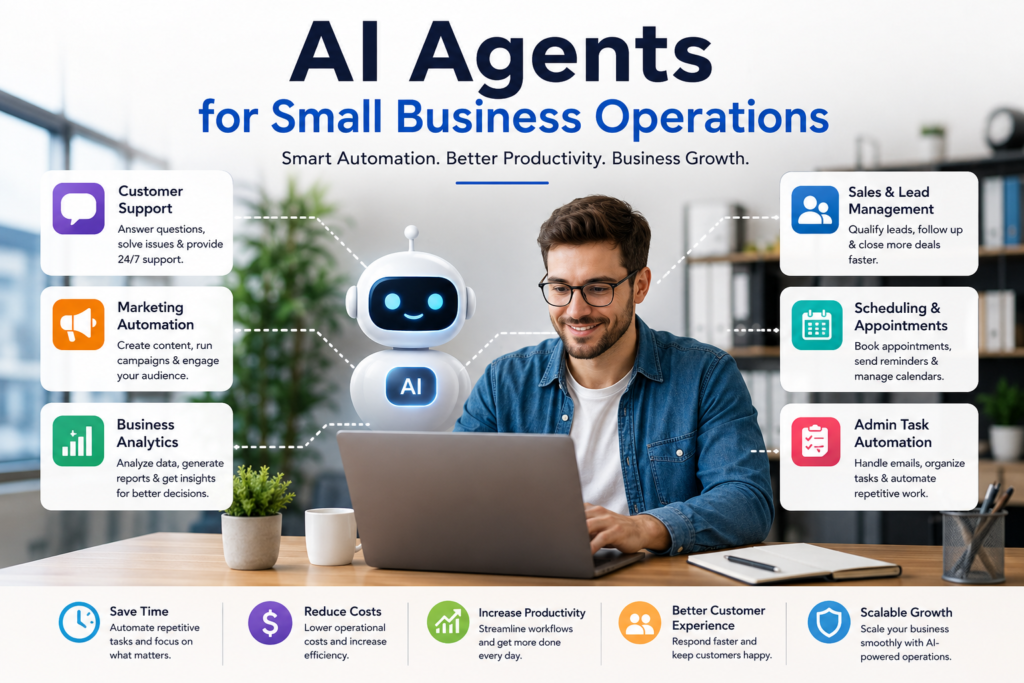
AI agents for small business operations are intelligent software systems designed to perform specific business tasks with limited human intervention. They can use AI models, connected applications, business data, and automation tools to complete workflows.
For example, an AI agent can receive a customer inquiry, identify the customer’s needs, prepare a response, and direct the request to the appropriate team member.
AI agents may help businesses with:
-
Customer communication and support.
-
Marketing and content creation.
-
Lead management and sales.
-
Administrative workflows.
-
Data analysis and reporting.
-
Scheduling and appointment management.
These systems can help small teams accomplish more without immediately hiring additional employees.
7 Ways AI Agents Can Improve Small Business Operations
1. AI Agents for Customer Support
Customer support is one of the most useful applications of AI agents for small business operations. Small businesses receive questions about products, services, shipping, prices, returns, appointments, and availability.
AI customer support agents can help answer frequently asked questions using business-approved information. They can assist customers through website chat, messaging platforms, and other supported communication channels.
Benefits:
-
Answer common customer questions.
-
Provide product or service information.
-
Help customers find relevant pages.
-
Handle basic inquiries outside business hours.
-
Forward complex issues to human staff.
AI agents should be configured with accurate information and clear escalation rules to avoid misleading customers.
2. AI Agents for Marketing Automation
Marketing often requires consistent effort, especially for small businesses with limited staff. AI agents can help plan campaigns, research audiences, generate content ideas, and organize marketing activities.
An AI marketing agent can help prepare social media posts, draft email campaigns, summarize customer feedback, and suggest content based on business goals.
Marketing tasks AI agents can support:
-
Create social media content drafts.
-
Generate email marketing ideas.
-
Research competitor content.
-
Organize marketing calendars.
-
Analyze campaign performance data.
These capabilities can help business owners maintain consistent marketing without spending hours on repetitive planning.
3. AI Agents for Sales and Lead Qualification
Sales management can become difficult when a small business receives inquiries through multiple channels. AI agents can help organize leads, identify customer interests, and prepare follow-up messages.
An AI sales agent can collect information from customer inquiries, categorize potential leads, and help sales teams prioritize prospects based on predefined criteria.
Key capabilities:
-
Organize incoming leads.
-
Categorize potential customers.
-
Draft follow-up emails.
-
Summarize sales conversations.
-
Update supported CRM systems.
AI agents can make lead management more organized, but sales decisions should still involve human judgment when important customer relationships or financial commitments are involved.
4. AI Agents for Email and Administrative Tasks
Administrative work is one of the biggest time-consuming responsibilities for small business owners. Managing emails, preparing documents, organizing files, and responding to requests can interrupt daily operations.
AI agents can assist with organizing information, drafting email replies, summarizing conversations, preparing documents, and handling supported administrative workflows.
Common administrative tasks:
-
Summarize long email conversations.
-
Draft professional email responses.
-
Organize information from documents.
-
Prepare meeting summaries.
-
Help manage repetitive office workflows.
By automating parts of administrative work, business owners can focus on customer relationships, business development, and important decisions.
5. AI Agents for Inventory and Operations Management
Businesses that sell physical products need to monitor inventory, track stock levels, and plan purchases. AI agents can help analyze inventory information and identify patterns that may require attention.
When connected to appropriate data sources, an AI agent can review stock information, summarize sales trends, and notify users about products that may need replenishment.
Operational benefits:
-
Analyze inventory data.
-
Identify products with low stock.
-
Summarize sales trends.
-
Assist with purchase planning.
-
Organize supplier information.
AI agents can support inventory decisions, but businesses should verify important stock quantities and supplier orders before taking action.
6. AI Agents for Scheduling and Appointment Management
Service-based businesses often spend time arranging appointments, answering scheduling questions, and sending reminders. AI agents can help simplify these activities by interacting with calendars and scheduling systems when appropriate permissions are available.
They can assist with booking requests, appointment reminders, availability checks, and scheduling-related customer communication.
Useful scheduling functions:
-
Help customers request appointments.
-
Check connected calendar availability.
-
Prepare confirmation messages.
-
Organize appointment information.
-
Assist with rescheduling requests.
This type of automation can be particularly helpful for consultants, salons, agencies, repair services, clinics, and other appointment-based businesses.
7. AI Agents for Business Analytics and Reporting
Small businesses need to understand sales, expenses, customer activity, and overall performance. However, analyzing spreadsheets and preparing reports can require significant time.
AI agents can analyze connected or uploaded business data, summarize important trends, and help prepare reports for decision-making.
Analytics tasks AI agents can help with:
-
Summarize sales performance.
-
Analyze customer feedback.
-
Organize expense information.
-
Identify trends in business data.
-
Prepare weekly or monthly reports.
AI-generated reports can make information easier to understand, but financial figures and important business conclusions should be checked before making decisions.
Best AI Tools for Small Business Operations
Several AI platforms can help small businesses implement AI agents and automation workflows.
| AI Tool | Main Purpose |
|---|---|
| ChatGPT | Research, documents, workflows, and business assistance |
| Zapier | Connecting applications and automating workflows |
| Make | Building visual business automation |
| HubSpot | CRM, sales, and marketing workflows |
| Tidio | Customer support automation |
| Microsoft Copilot | Business productivity and office assistance |
The right tool depends on your business needs, budget, existing software, and the tasks you want to automate. Some platforms provide ready-to-use AI features, while others allow businesses to build custom workflows.
How to Start Using AI Agents in a Small Business
Small businesses do not need to automate everything at once. A simple implementation strategy can help avoid unnecessary costs and complications.
-
Identify repetitive tasks: Find activities that consume time every day, such as answering emails, organizing leads, or preparing reports.
-
Choose one workflow: Start with a task that is relatively simple and low-risk.
-
Select an AI tool: Choose software that supports your existing applications and business requirements.
-
Test the automation: Review the agent’s output and identify mistakes before using it regularly.
-
Monitor performance: Measure time saved, accuracy, customer experience, and overall usefulness.
Starting with one workflow allows businesses to understand how AI agents work before expanding automation across other operations.
Frequently Asked Questions
1. What are AI agents for small business operations?
AI agents for small business operations are intelligent software systems that can perform or assist with business tasks such as customer support, marketing, sales, scheduling, reporting, and administration.
2. Can AI agents help small businesses save money?
Yes. AI agents can reduce repetitive manual work, improve productivity, and help small teams manage more tasks. Actual savings depend on the tools, implementation costs, and business workflows.
3. Do small businesses need coding skills to use AI agents?
No. Many AI tools offer no-code interfaces, ready-made automation templates, and simple integrations. Advanced custom workflows may require technical knowledge.
4. Which AI agent is best for a small business?
The best AI agent depends on the business. ChatGPT can help with general business workflows, Zapier can connect applications, HubSpot can support CRM activities, and Tidio can help automate customer support.
5. Can AI agents replace employees in small businesses?
AI agents can automate some repetitive tasks, but they are not complete replacements for employees. Human communication, judgment, relationship building, quality control, and complex decision-making remain important.
6. Are AI agents safe for small businesses?
AI agents can be useful when properly configured, but businesses should protect sensitive information, limit permissions, review automated actions, and avoid allowing unrestricted access to financial or confidential systems.
Conclusion
AI agents for small business operations are changing how small companies manage their daily work in 2026. From customer support and marketing to inventory management, scheduling, and reporting, AI agents can help automate repetitive activities and improve productivity. Small businesses do not need expensive infrastructure or large technical teams to begin. Many modern AI platforms offer accessible automation features that can be implemented gradually.