Apptage.com AI First Product A Complete Guide
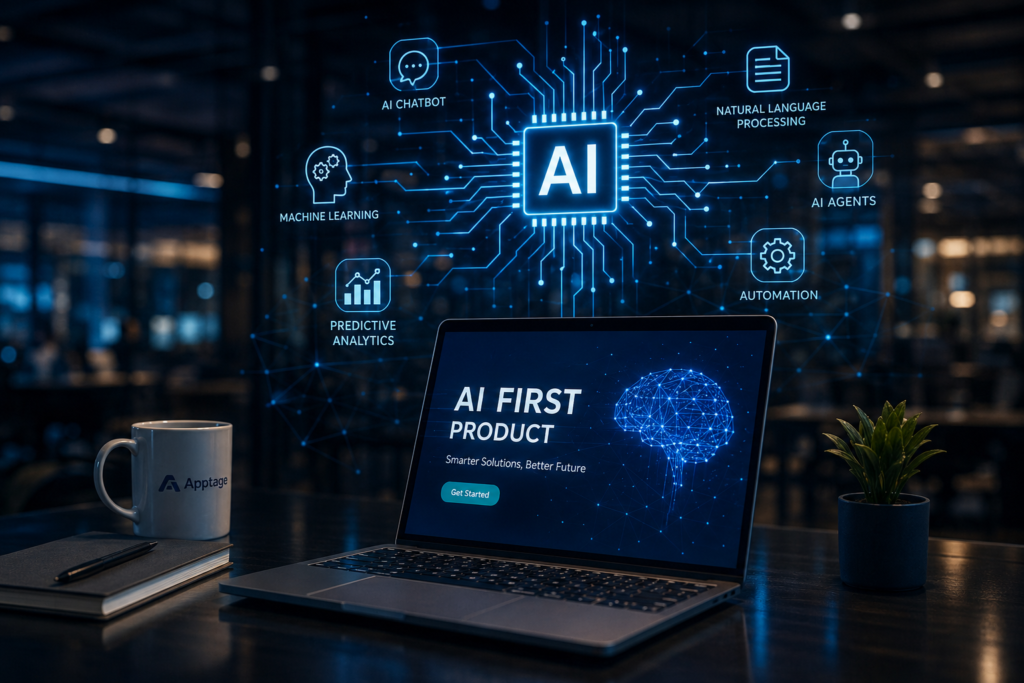
Artificial intelligence is changing how companies develop products, serve customers, and manage everyday operations. Businesses that once depended on traditional software are now exploring intelligent applications that can analyze information, automate repetitive work, and deliver more personalized experiences. This shift has created growing interest in AI-first product development.
The keyword apptage.com ai first product relates to this growing technology trend and Apptage’s role in developing modern digital solutions. Apptage.com AI First Product is a U.S.-based technology company that provides mobile app development, custom software, web development, and artificial intelligence services. Its AI capabilities include generative AI, machine learning, predictive analytics, natural language processing, and intelligent automation.
But what does an AI-first product actually mean? How can businesses benefit from this approach, and what makes a development company valuable when building intelligent software? Let’s explore Apptage, its AI capabilities, and the opportunities this technology creates for modern businesses.
What Is Apptage.com AI First Product?
The term Apptage.com AI First Product describes the idea of developing digital products with artificial intelligence at the center of their design and functionality. Instead of building an ordinary application and adding AI features later, developers consider intelligent technology during the earliest planning stages.
This approach changes how software is designed. For example, a traditional customer support application might allow customers to submit questions and wait for an employee to respond. An AI-first version could understand customer questions, provide relevant answers, organize requests, and direct complicated issues to the right department.
Apptage focuses on developing customized digital solutions for businesses. Its publicly described services include AI development alongside mobile applications, websites, cloud solutions, and custom software. Therefore, the keyword should be understood as a topic about its AI-first development capabilities rather than the name of one separately confirmed standalone product.
The main objective is simple: create useful technology that solves real business problems. AI should improve the product experience instead of being included simply because artificial intelligence is popular.
Understanding Apptage as a Technology Company
Apptage.com AI First Product is a technology and digital development company headquartered in South Jordan, Utah, United States. According to its official website, the company works with startups, small businesses, and larger organizations across the United States.
Its services cover several areas of digital development. These include mobile application development, custom software, web development, e-commerce solutions, product design, cloud consulting, and artificial intelligence.
This combination is important because building a successful AI product requires more than selecting an AI model. A business also needs an effective user interface, reliable software infrastructure, secure data management, and a development strategy that supports future growth.
Apptage presents its development process as a structured journey that includes understanding business requirements, planning, design, development, testing, and deployment. This approach can help organizations turn early ideas into practical digital products.
Businesses interested in learning more can visit the official website at https://www.apptage.com/.
What Makes an AI-First Product Different?
An AI-first product is designed around intelligent capabilities from the beginning. Artificial intelligence influences how the application operates, how users interact with it, and how it delivers value.
Traditional software generally follows predefined instructions. It performs tasks according to rules created by developers. AI-powered software can go further by identifying patterns, processing information, generating responses, and supporting predictions based on available data.
AI Built Into the Product From Day One
Planning AI integration early can make the entire development process more effective. Developers can select appropriate technologies, prepare data systems, and design features that work naturally with intelligent capabilities.
Consider an online shopping platform. A conventional store displays products according to categories and manually configured recommendations. An AI-first shopping platform could analyze customer preferences, understand browsing behavior, and recommend relevant products.
This creates a more personalized experience. Customers may discover products more easily, while businesses can better understand shopping patterns.
However, AI recommendations still require accurate information, appropriate privacy controls, and regular testing. Intelligent technology works best when it supports a carefully designed product strategy.
Smarter Automation and Personalization
Automation is another important part of AI-first development. Businesses regularly handle repetitive tasks such as organizing documents, responding to common questions, preparing summaries, and processing customer requests.
AI systems can assist with many of these activities. This can reduce manual workloads and allow employees to spend more time on complex responsibilities.
Personalization also creates opportunities. An educational platform, for example, could recommend learning materials based on a student’s progress. A customer service application could provide answers based on a user’s previous interactions.
These features demonstrate how AI can make software more responsive to individual needs.
Main AI Technologies Offered by Apptage.com AI First Product
Apptage publicly describes several artificial intelligence capabilities that can support different business requirements. The right technology depends on the problem a company wants to solve.
Generative AI and Machine Learning
Generative AI allows software to create new content, including written responses, images, and other outputs. Businesses can use these systems for content assistance, internal knowledge tools, product design support, and customer communication.
Machine learning focuses on identifying patterns in data and using those patterns to make predictions or classifications. For example, a retail company might use machine learning to understand purchasing trends and improve inventory planning.
These technologies can work together. A business application could use machine learning to identify customer preferences and generative AI to create personalized responses.
The quality of the results depends on suitable data, proper implementation, and ongoing evaluation.
Natural Language Processing and AI Agents
Natural language processing, commonly called NLP, helps computers understand and process human language. It supports applications such as chatbots, voice assistants, sentiment analysis, and language translation.
For example, a customer could ask a question using ordinary language instead of navigating several menus. An NLP-powered application could interpret the request and provide a useful response.
AI agents offer another development opportunity. They can be designed to perform specific tasks, assist users, and coordinate certain business workflows.
Apptage.com AI First Product lists AI agent development among its capabilities. These systems can support customer assistance, workflow automation, and other business activities, depending on how they are designed and integrated.
How Businesses Can Use AI-First Products
AI-first products are useful across many industries because different organizations face different operational challenges.
In healthcare, AI applications can help organize information, support administrative processes, and assist with certain analytical tasks. Healthcare professionals must still review important decisions, and sensitive information requires strong privacy protections.
In e-commerce, intelligent recommendations can help customers discover relevant products. Retail businesses can also explore demand forecasting and automated customer support.
Financial organizations may use machine learning to identify unusual transaction patterns and support risk analysis. Educational companies can build applications that adapt learning materials to individual progress.
Manufacturing businesses can explore predictive maintenance systems that analyze equipment information and identify possible problems before major failures occur.
These examples show that AI-first development is not limited to one industry. The most successful applications begin with a clearly defined problem and use appropriate technology to address it.
Benefits of AI-First Product Development
One major benefit of AI-first development is efficiency. When intelligent automation handles suitable repetitive activities, employees can focus on planning, communication, and other valuable responsibilities.
Another advantage is personalization. AI-powered applications can provide experiences that better match individual customer requirements. This can make digital products more useful and improve customer engagement.
Scalability is also important. Businesses need software that can adapt as customer numbers, data volumes, and operational requirements increase. Properly designed AI systems can become part of a larger digital infrastructure.
AI-first development may also support better decision-making. Analytical tools can help organizations understand patterns and identify opportunities that might otherwise be difficult to notice.
Here is a simple comparison:
| Feature | Traditional Software | AI-First Software |
|---|---|---|
| Automation | Mainly predefined rules | Can support intelligent automation |
| Personalization | Often limited | Can adapt using relevant data |
| Data analysis | Usually rule-based | Can identify complex patterns |
| Customer support | Often menu-based | Can include intelligent assistants |
| Recommendations | Manually configured | Can use machine learning |
| Development strategy | AI may be added later | AI considered from the beginning |
These benefits are not automatic. Results depend on product design, implementation quality, data accuracy, and the needs of actual users.
Challenges and Important Considerations
Despite its advantages, AI development also comes with challenges. One of the biggest concerns is data quality. An AI system trained or configured with incomplete information may produce inaccurate results.
Privacy and security are equally important. Businesses must understand what information their applications collect, how it is processed, and who can access it.
Another challenge is cost. Developing custom AI software may require experienced developers, infrastructure, testing, and ongoing maintenance. Smaller businesses should identify their priorities before investing in a large project.
Companies should also consider human oversight. AI can make mistakes, misunderstand requests, or generate unreliable information. Important decisions should include suitable review processes.
Working with an experienced development partner can help organizations plan these requirements. Before starting a project with Apptage or another provider, businesses should discuss pricing, timelines, ownership rights, security practices, deliverables, and post-launch support.
How to Get Started With AI Development
Starting an AI project does not require a complicated idea. In fact, a focused solution is often a better starting point than an application attempting to solve every business problem.
Begin by identifying one repetitive task or customer problem that could benefit from intelligent technology. Next, consider whether AI is genuinely necessary or whether traditional automation would provide a simpler solution.
After defining the problem, prepare a basic project plan. Identify the intended users, essential features, available data, expected results, and security requirements.
The next stage involves discussing technical options with a development team. Apptage.com AI First Product offers AI development services that include custom AI solutions, machine learning, generative AI, and automation.
Once the technical direction is clear, developers can create a prototype, test its functionality, collect feedback, and improve the experience before a wider launch.
A successful launch should not be treated as the final step. Monitoring, maintenance, and improvements help ensure that the application continues to meet changing business needs.
The Future of AI-First Products
The future of digital products will likely involve deeper integration between artificial intelligence, automation, cloud computing, and data analytics.
AI assistants are becoming increasingly useful for handling everyday digital tasks. Businesses are also exploring AI agents that can coordinate workflows and support employees with more complicated activities.
Personalized applications may become more common as companies learn how to use customer information responsibly. Intelligent software could also make digital services easier to access by allowing users to interact through natural language.
For development companies such as Apptage, these changes create opportunities to build customized solutions for different industries. However, long-term success will depend on more than adopting new technology.
Companies will need to focus on security, reliability, user experience, transparency, and measurable results. Products that solve real problems will remain more valuable than applications that simply follow technology trends.
Conclusion
The Apptage.com AI First Product topic highlights an important change in modern software development: artificial intelligence is becoming part of the foundation of digital products rather than an optional feature.
Apptage offers AI development capabilities alongside mobile applications, custom software, web platforms, and cloud services. Its publicly described technologies include generative AI, machine learning, natural language processing, predictive analytics, and AI agents.
For businesses, AI-first development can create opportunities to improve automation, personalize customer experiences, and make better use of information. However, every project needs clear goals, reliable data, strong security, and ongoing testing.
The smartest approach is to begin with a genuine business challenge and choose technology that delivers practical value. With the right planning and development strategy, AI-first products can become an important part of future business growth.
Frequently Asked Questions
1. What is Apptage.com AI First Product?
It refers to the topic of AI-first digital product development associated with Apptage.com AI First Product AI capabilities. It describes designing applications with artificial intelligence as a central part of their functionality.
2. What AI services does Apptage offer?
Apptage publicly lists generative AI, machine learning, natural language processing, predictive analytics, AI automation, and AI agent development among its capabilities.
3. Can small businesses benefit from AI-first products?
Yes. Small businesses can use AI applications for customer support, document processing, workflow automation, and personalized services. The best starting point is a focused solution that addresses a real business need.
4. Is AI-first software better than traditional software?
Not in every situation. AI-first software can provide intelligent automation and personalization, but traditional software may be more affordable and reliable for simple tasks. The right choice depends on the project.
5. How can I learn more about Apptage AI development?
You can visit the official website at https://www.apptage.com/ and explore its artificial intelligence development services, available solutions, and contact information.