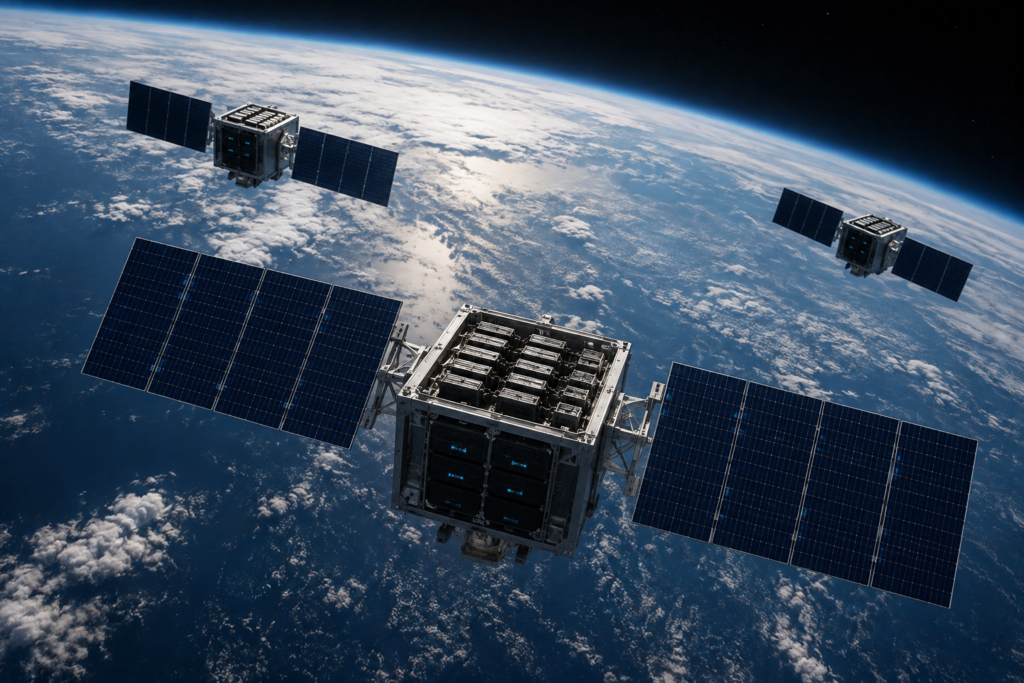
The future of artificial intelligence may not depend entirely on data centers built on Earth. SpaceX is exploring a revolutionary approach that could move large-scale computing infrastructure into orbit, using satellites powered by solar energy to support growing artificial intelligence demands. The concept of SpaceX satellite data centers has recently gained significant attention after the company received regulatory approval for a massive orbital computing project.
The idea is to create a network of satellites equipped with computing systems capable of processing AI workloads in space. Instead of relying entirely on traditional data centers that require enormous amounts of electricity, land, cooling infrastructure, and water, SpaceX wants to explore whether orbital infrastructure can provide a new solution.
This ambitious proposal could reshape the future of AI infrastructure, space technology, cloud computing, and satellite communications. However, the project also faces significant engineering, financial, environmental, and regulatory challenges.
SpaceX Receives Approval for One Million Orbital Satellites
One of the biggest developments surrounding this project came on November 25, 2026, when the Federal Communications Commission (FCC) approved SpaceX’s request for up to one million satellites designed to support orbital computing infrastructure.
According to reports, FCC Chairman Brendan Carr announced the approval, describing the satellites as orbital compute modules intended to create data centers in space. Elon Musk also acknowledged the decision, highlighting the potential importance of the project for the United States and the wider world.
The approval represents a significant regulatory milestone, although it does not mean that one million satellites will be launched immediately. The project would require years of engineering, manufacturing, deployment, testing, and infrastructure development.
The scale of the proposal highlights SpaceX’s ambitions in the AI industry. The company already operates a large satellite network through Starlink, and it could potentially use its experience in satellite manufacturing, launch operations, and orbital communications to support future computing systems.
How SpaceX Satellite Data Centers Could Work
Traditional data centers are facilities filled with servers, networking equipment, storage systems, and cooling infrastructure. These facilities support AI models, cloud services, websites, business applications, and digital platforms.
Space-based computing would use similar hardware, but instead of operating inside buildings on Earth, the computing equipment would be placed inside specially designed satellites.
The concept behind SpaceX satellite data centers involves deploying computing modules into orbit and connecting them through advanced communication systems. These satellites could communicate with each other and potentially transmit information to Earth through satellite communication networks.
The system could potentially use:
-
Solar panels to generate electricity.
-
Computing hardware to process AI workloads.
-
Optical or radio communication systems to transfer information.
-
Satellite networking technology to connect orbital modules.
-
Specialized thermal management systems to control hardware temperatures.
Rather than depending on large power grids on Earth, orbital computing satellites could generate electricity from sunlight. This is one of the reasons technology companies are investigating space-based data centers as a possible long-term solution for AI infrastructure.
Why SpaceX Wants to Build Data Centers in Space
Artificial intelligence is increasing the demand for computing resources around the world. AI models require powerful processors, large amounts of electricity, data storage, and cooling systems.
Building traditional data centers can be expensive and complicated. Companies need suitable land, access to electricity, water resources, construction materials, networking infrastructure, and permission from local authorities.
The concept of SpaceX satellite data centers could potentially address some of these limitations over the long term.
Solar Energy Could Provide a Major Power Source
Solar power is one of the most attractive advantages of orbital computing. Satellites can use solar panels to collect sunlight and convert it into electricity.
Depending on their orbit and design, certain satellites could receive substantial sunlight, potentially reducing dependence on conventional energy sources.
For AI companies, access to reliable power is increasingly important. As AI systems become more advanced, electricity demand for computing infrastructure continues to grow.
Space-based solar energy could eventually become an alternative for certain computing workloads if the technology becomes economically practical.
Reducing Pressure on Earth-Based Data Centers
Data centers on Earth require physical infrastructure and significant resources. Some large facilities use considerable amounts of water for cooling, while others depend on complex electricity systems.
Space-based computing could potentially reduce the need for certain terrestrial infrastructure in the future.
However, orbital facilities would not eliminate the need for data centers on Earth. Most internet services, enterprise applications, and everyday computing activities would likely continue using terrestrial infrastructure for many years.
The potential benefit would be adding another layer of computing capacity rather than immediately replacing existing facilities.
The Biggest Challenges Facing Orbital AI Infrastructure
Although the idea sounds promising, developing SpaceX satellite data centers will not be simple. Space is a difficult environment for advanced computing hardware, and engineers must solve several technical problems before large-scale orbital infrastructure becomes practical.
Cooling Computer Hardware in Space
One of the most difficult challenges is managing heat.
AI processors generate considerable heat when performing demanding calculations. Earth-based data centers typically use air cooling, liquid cooling, chillers, and other technologies to maintain safe operating temperatures.
Space is not automatically a cold environment for computer equipment. In the vacuum of space, heat cannot easily transfer through air because there is no surrounding atmosphere. Engineers must rely on radiation and specially designed thermal systems to remove excess heat.
The U.S. Government Accountability Office has identified cooling as one of the major engineering challenges facing space-based data centers.
Radiation and Hardware Reliability
Satellites operate in an environment exposed to radiation, which can damage electronic components or cause computing errors.
AI processors, memory systems, networking equipment, and storage devices would need protection against radiation-related problems. Engineers may use shielding, fault-tolerant systems, specialized electronics, and software techniques to improve reliability.
The longer satellites operate in orbit, the more important hardware reliability becomes.
Launching and Maintaining Satellites
SpaceX has experience launching satellites, but orbital data centers could require more advanced equipment than ordinary communication satellites.
Large computing systems may need bigger solar panels, additional thermal management equipment, stronger communication systems, and more complicated designs. Manufacturing and launching such infrastructure could require substantial investment.
How Orbital Data Centers Could Support Artificial Intelligence
AI development is creating new demands for computing infrastructure. Businesses, researchers, developers, and technology companies need powerful systems to train models, process information, and run AI applications.
The idea behind SpaceX satellite data centers is to explore whether computing workloads could eventually be handled by networks of satellites instead of relying exclusively on facilities on Earth.
Possible applications could include:
-
AI computation for specialized workloads.
-
Processing information collected by satellites.
-
Scientific research and space exploration.
-
Data processing for remote sensing.
-
Computing services connected through satellite networks.
One particularly interesting application is processing data directly in space.
Earth-observation satellites collect enormous amounts of information about weather, oceans, agriculture, forests, infrastructure, and environmental changes. Sending every piece of raw data to Earth can require significant communication resources.
Orbital computing systems could potentially process information before transmitting selected results to ground stations.
This approach may improve efficiency for certain satellite-based applications.
SpaceX’s Timeline for Orbital Computing
SpaceX’s proposal is ambitious, and the deployment timeline is expected to be gradual rather than immediate. The company’s filings and reported plans indicate that orbital AI computing satellites could begin deployment as early as 2028, although timelines for large-scale infrastructure may change as engineering and regulatory requirements evolve.
The first stages could involve testing smaller systems, validating communication technologies, evaluating solar power capabilities, and developing solutions for thermal management. The company would also need to demonstrate that orbital computing can compete economically with conventional data centers.
The future of SpaceX satellite data centers will depend on whether the company can make the technology affordable, reliable, and scalable.
Could Space-Based Data Centers Become a Global Technology Trend?
The idea of moving computing infrastructure into space is not limited to one company. Technology businesses, researchers, and governments are exploring different approaches to orbital computing.
The Government Accountability Office has highlighted potential benefits, including reduced resource demands on Earth and the ability to process satellite-generated data more efficiently. However, the agency also identifies economic, environmental, engineering, and orbital safety concerns.
If the technology becomes practical, SpaceX satellite data centers could become part of a broader space-based computing ecosystem.
Future networks could combine satellites, ground stations, terrestrial cloud systems, AI software, and advanced communication infrastructure. Such systems might support scientific research, specialized AI processing, and data-intensive operations.
Nevertheless, the industry still needs to prove that orbital computing can deliver meaningful economic advantages compared with traditional facilities.
Environmental and Space Safety Concerns
Launching large numbers of satellites raises concerns about space debris, orbital congestion, and the long-term sustainability of Earth’s orbital environment.
More satellites could increase the probability of collisions, potentially affecting other spacecraft and future space missions.
Researchers are also concerned about the impact of satellite constellations on astronomy, radio communications, and the management of orbital resources.
The expansion of SpaceX satellite data centers would therefore need to consider responsible satellite deployment, collision avoidance, satellite disposal, and international cooperation.
Regulatory approval is only one part of the process. Long-term sustainability will also be important for the project’s success.
Conclusion
SpaceX’s orbital computing proposal represents an ambitious attempt to address the growing demand for artificial intelligence infrastructure. The FCC’s approval for up to one million orbital computing satellites marks an important regulatory milestone, but the actual development and deployment of such a large network could take years.
SpaceX satellite data centers could potentially benefit from solar energy, interconnected satellite networks, and the ability to process certain data directly in orbit. However, cooling systems, radiation protection, launch costs, hardware reliability, and space safety remain significant challenges.
If these challenges can be overcome, orbital computing could become an additional part of the global AI infrastructure. For now, the project remains an ambitious technological vision with the potential to influence the future of artificial intelligence, satellite communications, and space exploration.