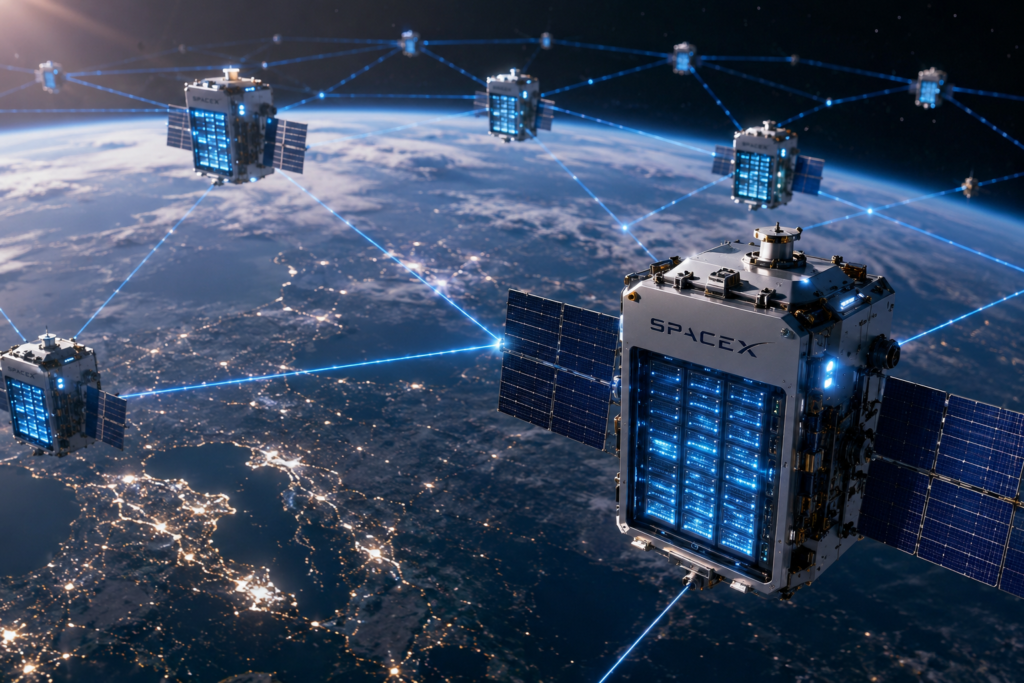
The future of artificial intelligence may not depend entirely on computers located on Earth. SpaceX is exploring a massive new vision that could move AI computing infrastructure into space. The SpaceX 1 million AI satellites proposal has attracted global attention because it could transform how data centers are powered, connected, and expanded in the coming years.
SpaceX has reportedly submitted a proposal to U.S. regulators seeking approval for up to one million satellites designed to support orbital data centers. Instead of simply providing internet connectivity like traditional Starlink satellites, these proposed spacecraft could help process artificial intelligence workloads directly in orbit.
The idea represents a major shift in the relationship between space technology and AI infrastructure. If the plan eventually becomes reality, it could open new possibilities for AI development, computing power, and global digital infrastructure.
What Is the SpaceX 1 Million AI Satellites Plan?
The SpaceX 1 million AI satellites plan involves building a large orbital network of satellites capable of supporting artificial intelligence computing. These satellites would potentially work together as an orbital data center system.
Traditional AI data centers require enormous amounts of electricity, cooling systems, land, networking equipment, and advanced infrastructure. As AI models become more powerful, companies are investing billions of dollars in facilities capable of handling growing computing demand.
SpaceX’s proposed concept could move some of these computing systems into orbit around Earth.
According to the proposal reported in February 2026, the company is considering satellites operating at orbital altitudes ranging from approximately 500 to 2,000 kilometers. These satellites could use solar energy to power computing systems while communicating with other satellites and ground infrastructure.
The project is still a proposal, rather than an operational million-satellite network.
Why SpaceX Wants AI Data Centers in Orbit
The growing demand for artificial intelligence is putting pressure on conventional data centers. AI systems require powerful GPUs, advanced networking infrastructure, and electricity to train models and process user requests.
Space-based AI infrastructure could offer several potential advantages.
1. Access to Solar Energy
Satellites in suitable orbits can access sunlight for significant periods, potentially allowing solar panels to generate electricity for onboard systems. SpaceX’s concept highlights solar energy as one of the potential advantages of orbital AI computing.
However, solar power in space does not automatically make computing cheaper. Satellites still need batteries, power-management systems, thermal controls, and reliable hardware.
2. Reducing Dependence on Land-Based Data Centers
Building large data centers on Earth can require significant land, electrical infrastructure, water resources, and local planning approvals.
Orbital data centers could offer an alternative location for certain computing workloads. Instead of expanding every AI computing facility on Earth, companies might eventually deploy computing infrastructure in orbit.
This could become particularly interesting as demand for AI processing continues to grow across businesses, cloud platforms, and consumer applications.
3. Global Connectivity
SpaceX already operates Starlink, a satellite internet network designed to connect people and businesses around the world.
An orbital AI computing network could potentially work alongside satellite connectivity systems, allowing data to move between satellites, ground stations, and connected users. This combination could help create an integrated space-based infrastructure for internet connectivity and artificial intelligence.
How SpaceX AI Satellites Could Work
The proposed system would require satellites with computing hardware, solar power systems, communication equipment, and thermal management technology.
A simplified explanation of how the technology could work includes the following stages:
-
Solar power generation: Satellites collect energy using solar panels.
-
AI computing: Specialized hardware processes selected AI workloads in orbit.
-
Satellite networking: Spacecraft communicate with one another and potentially transfer computing tasks.
-
Data transmission: Information is sent between orbital infrastructure and Earth-based networks.
-
AI services: Processed information could support applications requiring AI inference or other computing tasks.
This architecture would require sophisticated hardware capable of surviving radiation, temperature fluctuations, launch conditions, and the long-term challenges of operating in space.
SpaceX’s AI Infrastructure Ambitions
SpaceX’s interest in orbital computing is connected to the broader expansion of AI infrastructure and its relationship with xAI.
In a 2026 SEC filing, SpaceX described how its rocket technology, satellite manufacturing capabilities and operational experience could support massive orbital AI computing systems. The filing also discussed the potential deployment of orbital AI satellites beginning as early as 2028.
The proposed infrastructure could eventually support AI workloads such as inference, where trained AI models generate answers, predictions, content, or other outputs.
The broader strategy could combine reusable launch vehicles, satellite manufacturing, internet connectivity, and AI development into a connected technology ecosystem.
What Makes One Million Satellites a Big Deal?
The number itself is one of the most extraordinary aspects of the proposal.
SpaceX already operates thousands of Starlink satellites. According to its 2026 SEC filing, the company reported approximately 9,600 Starlink broadband and mobile satellites in low-Earth orbit as of March 31, 2026.
A network of one million AI satellites would represent a dramatically different scale of space infrastructure.
Such a network could introduce new challenges involving:
-
Satellite collision prevention
-
Orbital traffic management
-
Space debris
-
Radio-frequency interference
-
Astronomical observations
-
Satellite manufacturing costs
-
International space regulations
Astronomers and space experts have raised concerns about the safety and environmental implications of extremely large satellite constellations. Managing millions of spacecraft would require advanced tracking, coordination, and orbital management systems.
Could Orbital AI Data Centers Be Cheaper?
SpaceX believes orbital computing could eventually become an attractive alternative to some terrestrial AI infrastructure. Space offers access to solar energy, but the economics remain uncertain.
Launching computing equipment into orbit is expensive. Hardware must also be designed to survive radiation, extreme temperatures, and difficult repair conditions.
Cooling is another major challenge. Space does not provide conventional air cooling, and equipment must transfer heat through specialized thermal systems.
The financial benefits would depend on launch costs, satellite lifespan, computing efficiency, maintenance, energy generation, and networking performance.
Therefore, orbital AI data centers could become an important technology, but they are not guaranteed to replace Earth-based data centers.
When Could SpaceX Launch AI Satellites?
SpaceX’s plans are still developing. The company has discussed the potential deployment of orbital AI computing satellites as early as 2028, according to its 2026 filing.
That timeline represents a stated ambition, not a guarantee that the entire constellation will be deployed by that date.
The initial stages could involve testing computing hardware, communication systems, solar power infrastructure, and satellite networking capabilities before any large-scale deployment.
If successful, the technology could gradually expand as launch systems and orbital computing platforms become more advanced.
How SpaceX 1 Million AI Satellites Could Change the AI Industry
The SpaceX 1 million AI satellites proposal highlights a growing trend in the technology industry: building new infrastructure to support the rapidly increasing demand for artificial intelligence.
Future AI services may require more computing power, faster networks, and increasingly efficient energy systems. Orbital computing could become one possible solution to these challenges.
SpaceX’s combination of rocket technology, Starlink connectivity, and AI infrastructure ambitions could create a new category of computing services if the technical and financial challenges can be overcome.
For technology companies, developers, businesses, and AI researchers, orbital data centers represent an interesting possibility for the next generation of digital infrastructure.
Frequently Asked Questions (FAQs)
What is SpaceX 1 million AI satellites?
It is a proposed SpaceX project involving up to one million satellites designed to support AI computing infrastructure and orbital data centers.
Why does SpaceX want AI satellites?
The concept aims to provide computing infrastructure in space, potentially using solar energy and satellite networking to support AI workloads.
When could SpaceX launch AI satellites?
SpaceX has discussed potentially beginning deployment as early as 2028, although the timeline is not guaranteed.
Will SpaceX AI satellites replace data centers on Earth?
Not necessarily. Orbital computing could complement terrestrial data centers, but launch costs, cooling, hardware reliability, and networking challenges remain significant.
Are one million SpaceX AI satellites already in orbit?
No. The million-satellite network is a proposal, not an existing operational constellation.